Welcome
 The Tennessee State University Automated Astronomy Group is part of the
Center of Excellence in Information Systems, a multidisciplinary research
laboratory founded in 1986 within the state-wide Centers of Excellence
program to increase the amount of research being done at state universities
across Tennessee. The Center consists of faculty, graduate and undergraduate
students, researchers, postdocs, and support staff in the areas of astronomy
with automated telescopes, advanced control systems and systems
identification, and applied mathematics. The Center is located on the top
floor of TSU's Research and Sponsored Programs Building on the northwest side of TSU's main campus in Nashville.
The Tennessee State University Automated Astronomy Group is part of the
Center of Excellence in Information Systems, a multidisciplinary research
laboratory founded in 1986 within the state-wide Centers of Excellence
program to increase the amount of research being done at state universities
across Tennessee. The Center consists of faculty, graduate and undergraduate
students, researchers, postdocs, and support staff in the areas of astronomy
with automated telescopes, advanced control systems and systems
identification, and applied mathematics. The Center is located on the top
floor of TSU's Research and Sponsored Programs Building on the northwest side of TSU's main campus in Nashville.

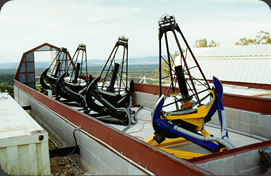
The Automated Astronomy Group conducts a variety of astronomical research
programs with automatic (robotic) telescopes located at Fairborn Observatory
in the Patagonia Mountains near Washington Camp, Arizona. The Automated
Astronomy Group has been active since 1989 and has research interests in
long-term brightness and magnetic cycles in Sun-like stars, the search for
planetary systems  around other
stars, chromospherically active (spotted) stars, the properties of binary and
multiple stars, Zeta Aurigae binaries, the structure and heating of stellar
chromospheres, slowly-pulsating stars, and developing the capabilities of
robotic telescopes for automated photometry, spectroscopy, and imaging.
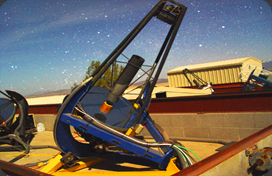
Center of Excellence astronomers now operate six 0.40m to 0.80m Automatic
Photoelectric Telescopes (APTs), a 2.0m Automated Spectroscopic Telescope
(AST) and a 0.36m Automated Imaging Telescope (AIT). A short history of
Fairborn Observatory and the development of robotic telescopes is available
here and here.
around other
stars, chromospherically active (spotted) stars, the properties of binary and
multiple stars, Zeta Aurigae binaries, the structure and heating of stellar
chromospheres, slowly-pulsating stars, and developing the capabilities of
robotic telescopes for automated photometry, spectroscopy, and imaging.
Center of Excellence astronomers now operate six 0.40m to 0.80m Automatic
Photoelectric Telescopes (APTs), a 2.0m Automated Spectroscopic Telescope
(AST) and a 0.36m Automated Imaging Telescope (AIT). A short history of
Fairborn Observatory and the development of robotic telescopes is available
here and here.
A celebration of the 10th Anniversary of the discovery of the first extrasolar planet can be found here.
Funding support for automated astronomy has been provided by NASA, NSF, Tennessee State University, and the State of Tennessee through its Centers of Excellence Program.
Research results throughout Tennessee State University can be found at TSU's Digital Scholarship website.